Fr Eugene Stockton – 30/11/1934 - 5/8/2026
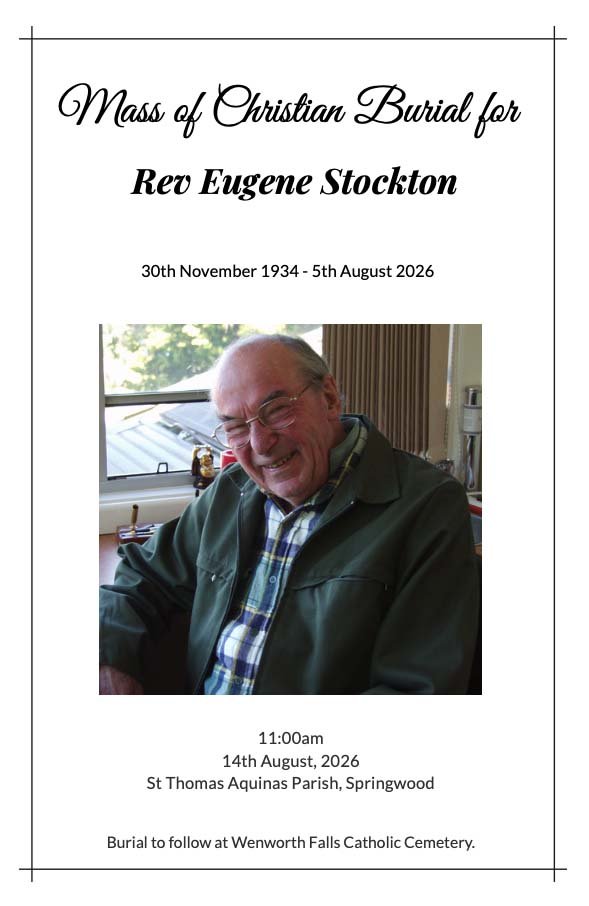
Eugene Eulogy 14th August 2026
Now there is going to be a quiz… it will be not hard… are you ready?
My name is Stephen Eugene Stockton… I am Eugene’s nephew.
Question; How did I get my middle name?
Thank you for coming today to say farewell to Eugene.
Today, you are going to hear all about Eugene’s achievements from his amazing friends and colleagues, I am sure you may even learn something new too.
I only have a few minutes, and so, I will be giving you a very quick, brief insight about my uncle, purely from my perspective.
I am not a religious person, although I do have big heart and I love logic. I valued the fact, that Eugene has never, ever forced religion, or his views, down my neck. We have always simply talked together, we listened and we laughed together.
When I had a religious question for Eugene, it was so handy to have a professional in the family, like a mechanic, Eugene was always incredibly honest and I loved his commonsense replies.
One example I will never forget was as a 16 year old… I said:
“Eugene, I know you are a priest, but I also know you are a scientist. You have made discoveries which have been dated over 40,000 years old!! How is it then that the bible teaches about Adam and Eve, or the world being created in seven days… isn’t there some contradiction here?”
My uncle was cool… he frankly said… “It’s just a story”.
We continued talking and Eugene told me about his friends, I think possibly in Jordan in the Middle East. His friends were Doctors, Professors and incredibly talented archaeologists however due to their faith, so as not to upset anyone, they had to believe, the fossils, they were investigating, were planted in the ground to be found… “Can you believe that?” he said.
I loved it when Eugene would share tales of his adventures.
Again, from the Middle East, one of the funniest stories Eugene told me was while he was in Jordan… he was arrested by the secret police for spying… and held in a jail for three days!!!
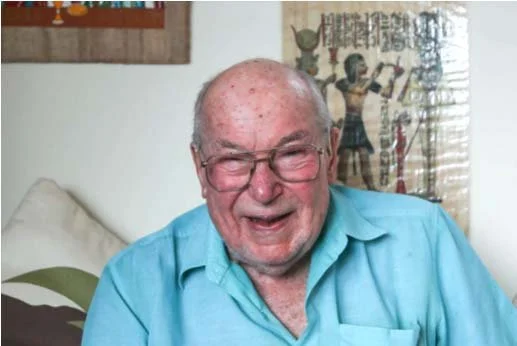
I saw a photo of Eugene at the time, and he seriously looked authentically Arabic with a great big Australian grin. I was seriously not surprised
I can only presume the secret police must have thought it very suspect that this desert chap with the weird accent, who was associating with their Doctors and Professors, was obviously up to no good.
Eugene said they asked him many, many questions during the three days, then he laughed out loud, “They eventually realised, I was stupid… and then they let me go”
Now this may surprise you…
From an early age, Eugene had a “well why not, just do it” attitude.
At the age of ten, Eugene realised that he and Winston Churchill shared the same birthday…. So, what does he do?
He writes a happy birthday letter to Winston Churchill obviously… and what happens next? Well Winston wrote back.
I quote; “I thank you sincerely for your kind message to me that I have received and read with great pleasure… Winston Churchill 1945”.
If you are interested, I am more than happy to show you a photo of the envelope and letter, taken by my mobile, after today’s ceremony.
Eugene was open minded. My sister Julie and I visited Eugene while he resided at Bucklands Nursing Home in Springwood, his room was decorated with religious paintings which were important to Eugene, however to my surprise, he also had small ornaments such as Buddha and Shiva and others. When I talked to Julie about this, Julie said that Eugene was just open to all expressions of belief and faith practices. It made sense, I really liked that.
I have barely scratched the surface with my uncle however I am going to conclude with a hugest thank you… to the massive tribe of Eugene’s friends and helpers. I am very proud to see Eugene was a member of a such a creative association of clever minds.
There will be refreshments at my home in 2 Somers Street Lawson, after Eugene’s Interment at Wentworth Falls cemetery.
You are all very welcome.
Thank you and cheers.
Stephen Eugene Stockton
2026 Funeral Homily for
Fr Eugene Stockton
Readings: Isaiah 40:3-8; Romans 8:14-18; John 1:1-14
Dear friends,
We gather to remember to our loving God the soul of Fr Eugene who served for more than 60 years in parishes across Sydney and Parramatta but has been given many titles: priest-archaeologist, scholar, teacher and educator; self-described ‘bush theologian’, Aboriginal Chaplain, entrepreneur, and Blue Mountains Hermit.
From an early age, the bush stirred his imagination, and he made a long-term commitment to ‘listening’ to the Australian bush or ‘his country’ as he fondly calls it. Growing up in Lawson, he took every chance to explore tracks, caves and swamps and listening to the behaviour of the native wildlife. The bush was his ‘playground’ and much later in life, he would recall these childhood experiences as foundational to his understanding of Aboriginal spirituality.
He was known as the “Indiana Jones” of the Catholic priesthood. He survived war zones, uncovered archaeological breakthroughs, tackled 14 languages, started the Aboriginal Catholic Ministry and found time to complete two doctorates for his work as a seminary lecturer. He joined the staff of St Columba’s College in 1962 and taught many seminarians who would make significant contributions to the Church and society in their turn. He undertook archaeological excavations at Kings Table Shelter Wentworth Falls, initially identifying a possible artefact in the Nepean gravels thought to be 40,000 years old, which was claimed to be the oldest human occupation in the Blue Mountains. Eugene was truly a pioneer in exploring not only the artefacts but also our First Peoples’ spirituality. His works have brought together the newfound ecological reverence and the Aboriginal sense of the land as their myths and symbols arise from the soil.
Eugene is a spiritual seeker and a mystic. In 2006, he actually made a public profession as a vowed hermit, in a ceremony presided by my predecessor Bishop Kevin Manning, at Our Lady of the Nativity. Hermits are assumed to be odd, anti-social, psychotic or just drop-outs from society. However, history has shown that the eremitical state can transform people and can be a means of "self-actualization”. Hildegard of Bingen, Julian of Norwich and even Francis of Assisi could be regarded as hermits. So, some solitaries are more successful than others in their way of life. Eugene was in good company and for those of us who know Eugene, he was a mystic with a heart of justice and a deep spirituality of companionship with those who suffer injustice.
The readings that Eugene himself chose speak of this spirituality. Isaiah gives a message of consolation to a battered people. He teaches them that God’s plan for their destiny is being achieved through those traumatic times. Using poetic metaphors, he calls them to change and conversion. “Let every valley be filled in and every mountain and hill be laid low”. Martin Luther King Jr used these very words of Isaiah in his famous “I have a dream” speech. He was in line with the prophetic tradition in calling for the dismantling of systemic injustice and the creation of an inclusive society.
Similarly, Eugene’s long friendship with Aboriginal people and his innate sense of social and moral justice led him to strive to reconnect Aboriginal people with their sites and histories. Eugene’s thoughts and actions resonate with the great Aboriginal gift to the nation, the Uluru Statement from the Heart. Here the ‘handshake across centuries’ is extended: a hand reaching out with the astoundingly generous invitation ‘to walk with us in a movement of the Australian people for a better future'
In the Gospel, John describes the birth of Jesus not only as a model human being for other humans but as the crowning embodiment of all that exists. The Incarnation is God revealing himself in the flesh of the Christ child that encapsulates the materiality of all creation. Hence, John declares that “all that came to be had life in him” and “He was in the world that had its being through him”. The Incarnation is God’s total Yes and unconditional love for us and for all his creatures.
The Incarnation opens us to the dawn of this new era of God’s justice, love and compassion in Christ. The default political and economic system that favours the powerful and disadvantages the powerless can no longer hold sway. Christ ushers in a new social order that levels the playing field and prioritizes the welfare and viability of the weakest links. The Incarnation beckons us to befriend and accompany the most dehumanised among us to achieve equity, justice, dignity and human flourishing.
We give thanks to God for a life richly lived and generously shared. We salute a mystic who taught us the sacramentality of all creation. In his own words, "We see the land as sacrament and icon of our mothering God. We look out for the coming of God’s Son to us in this land. As we enter more deeply into this mystical being about us. We will listen to the Spirit, the Breath of God, who for ages has blown through this land".
St Paul writes “all of us who possess the first-fruits of the Spirit, we too groan inwardly as we wait for our bodies to be set free”. May Eugene's mortal body be set free its slavery to decadence and may his soaring spirit hover over us. Let us commend him to the Creator God. Let us accompany him with our respects and prayers, confident that the greater crowning awaits a life well lived and a mission well accomplished. As we remember him, our love is rekindled, our hope strengthened, and our commitment renewed. May Christ is the way, the truth and the life who has guided him in his life also guide us on our pilgrimage until the day we are reunited with him and all our deceased loved ones.
Tribute to Fr Eugene Stockton
Throughout life there are rare occasions when you meet a truly remarkable person.
Fr Eugene Stockton was such a person.
He was inspiring and creative.
He was exceptionally generous and unworldly.
He had a delightful sense of fun and an extraordinary capacity for friendship.
He was academically brilliant in many fields—archaeology, languages, biblical studies, theology and spirituality—yet completely modest about his achievements.
He was a person of grace and deep Christian faith.
His spirituality was epitomised in four qualities—compassion, gentleness, patience and simplicity.
I said at the launch of the book we did in his honour two years agothat Eugene was a Blue Mountains treasure;
he was more than that,
he was also an outstanding Australian, a gift to the nation.
Unlike many of you, I didn’t get to know Eugene until 8 or 9 years ago when I became a trustee of the Blue Mountain Education and Research Trust that Eugene established in order to seek and diffuse cultural and spiritual wisdom that is inspired by the landscape and the peoples of the Blue Mountains
Before then I knew very little about him.
I knew he was a priest.
I knew he had written some books.
But I didn’t know about his archaeological work in the Blue Mountains and in the Middle East.
I didn’t know that he had written two doctoral theses:
one on the Holy Spirit in John’s Gospel and the other on Arabian Cult Stones.
I didn’t know that he had taught Scripture to seminarians and had worked among and with Indigenous people.
And, probably like many of you, I didn’t know that Eugene was a hermit!
For a hermit. Eugene was hyper-connected.
He loved receiving visitors.
And at times his small, one-bedroom cottage in Lawson was so crowded with visitors coming and going … that It was like the proverbial Pitt Street.
Eugene loved thinking up ideas for people to pursue.
Even when he could no longer do any sustained writing of his own, his fertile mind would be churning out ideas.
Eugene had a special affection for Indigenous people and unique insights into Aboriginal spiritualty.
He mentored young Aboriginal archaeologists.
Wayne Brennan, an archaeologist of Gamilaraay descent, said that Eugene not only helped him with archaeological matters but, more importantly, showed him a gentle way of working with people, with unabashed humility and honesty’.
Evelyn Parkin, an Indigenous theologian from North Stradbroke Island,(who will be coming in November to give 2026 Stockton Conversation), has written:
‘I'd like it to be known that Fr Eugene was loved, he was a great friend and great supporter to our Aboriginal and Islander Catholic Council.’
I said at the beginning of this tribute that it is a rare privilege to meet a person who gives depth and direction to one’s journey through life.
Eugene was such a person.
He didn’t like the word ‘mystic’ or even the word ‘saint’ being attributed to him.
So to me, he was a meteor, the likes of which I was blessed to behold.
William W. Emilsen
St Thomas Aquinas Church
14 August 2026